The Chill Zone
The Chill Zone: Justin Pugh
We sat down with Accounting Supervisor Justin Pugh to learn about his journey to Thermo-Kool, his thoughts on the industry, and his dream game to...
A school foodservice director signs off on a walk-in spec in late April. The dimensions fit. The compressor tonnage is right. The budget is approved. Then, six months after the kids are back in the cafeteria, a door starts sticking, a freezer alarm goes unheard, and staff begin propping the door open to work around the pressure.
The spec was right... but the planning was incomplete.
A walk-in cooler planning guide is less about dimensions and more about the decisions that compound over the next fifteen years. Most K-12 facility directors specify a new walk-in once a decade, maybe twice across a career, which makes planning a decisive phase, and one where operators have little direct experience to draw from.
Q2 is when most of these decisions get locked in, ahead of summer install and fall service. The common oversights cluster in five places. Name them during planning, and the spec gets stronger. Miss them, and the problem lives inside the wall.
Safety features belong in the base spec. A school walk-in cooler planning guide should confirm that interior emergency release, pressure relief, and staff-alert monitoring come standard on the quoted unit rather than being priced as upgrades.
When safety features are structured as add-ons, budget pressure tends to trim them during administrator review. Keeping them in the base protects the spec when the conversation turns to cost. Start with the core features of K-12 walk-in safety planning and work backward from there.
Low-bid decisions win the spec sheet and lose the decade. Panels, gaskets, compressors, and door hardware vary widely in durability, and the variance shows up five to seven years in, during service calls, not on the original invoice.
Ask the manufacturer what the unit looks like at year ten. Ask about panel integrity through temperature cycling, compressor duty cycles, and typical service call rates. Those answers separate a low price from a low cost. NSF/ANSI 7 sets the baseline sanitation and construction standard for commercial refrigeration, and most state health codes reference it. Confirm the walk-in meets it, and ask what the manufacturer includes beyond that baseline.
Flooring is part of the walk-in, not a finish decision to be made later. Schools should select flooring during the planning phase, based on how much product moves through the unit each day, how the space will be cleaned, and what the sanitation inspector needs to see
Slip resistance, drainage integration, and cove-base seal quality matter more than appearance. Thermo-Kool's flooring selector tool pairs operation type with the right assembly. Use it during the spec phase, before the order is final.
Monitoring catches two things people miss: temperature drift after hours, and a staff member inside the walk-in who hasn't walked back out. A school walk-in without monitoring is a walk-in without a safety net during the hours the kitchen is empty.
Spec a system that sends alerts for door-open faults, temperature excursions, and occupancy anomalies, and tie those alerts into a channel staff actually check. An alarm that rings in an empty room is not a safety feature. The monitoring technology built for K-12 walk-ins is worth specifying early, when it's a standard line and not a retrofit.
Freezer doors pull back against the operator after closing. That suction is the temperature differential equalizing, and it's normal. Left unaddressed, it becomes the reason staff prop doors open, bend handles, or stop using the freezer correctly.
Thermo-Kool's airlock relief valve solves the problem at the door. Ask whether the unit being quoted includes a pressure relief feature on the freezer specifically, and how it performs under real kitchen conditions. The cooler door and the freezer door are not the same engineering problem.
The Thermo-Kool Promise is plain: build it right the first time. That promise lives at the planning stage, not the loading dock. Schools that get the spec right inherit a walk-in that does what they planned for it to do, and keeps doing it through the next superintendent, the next nutrition director, and the next round of state inspections.
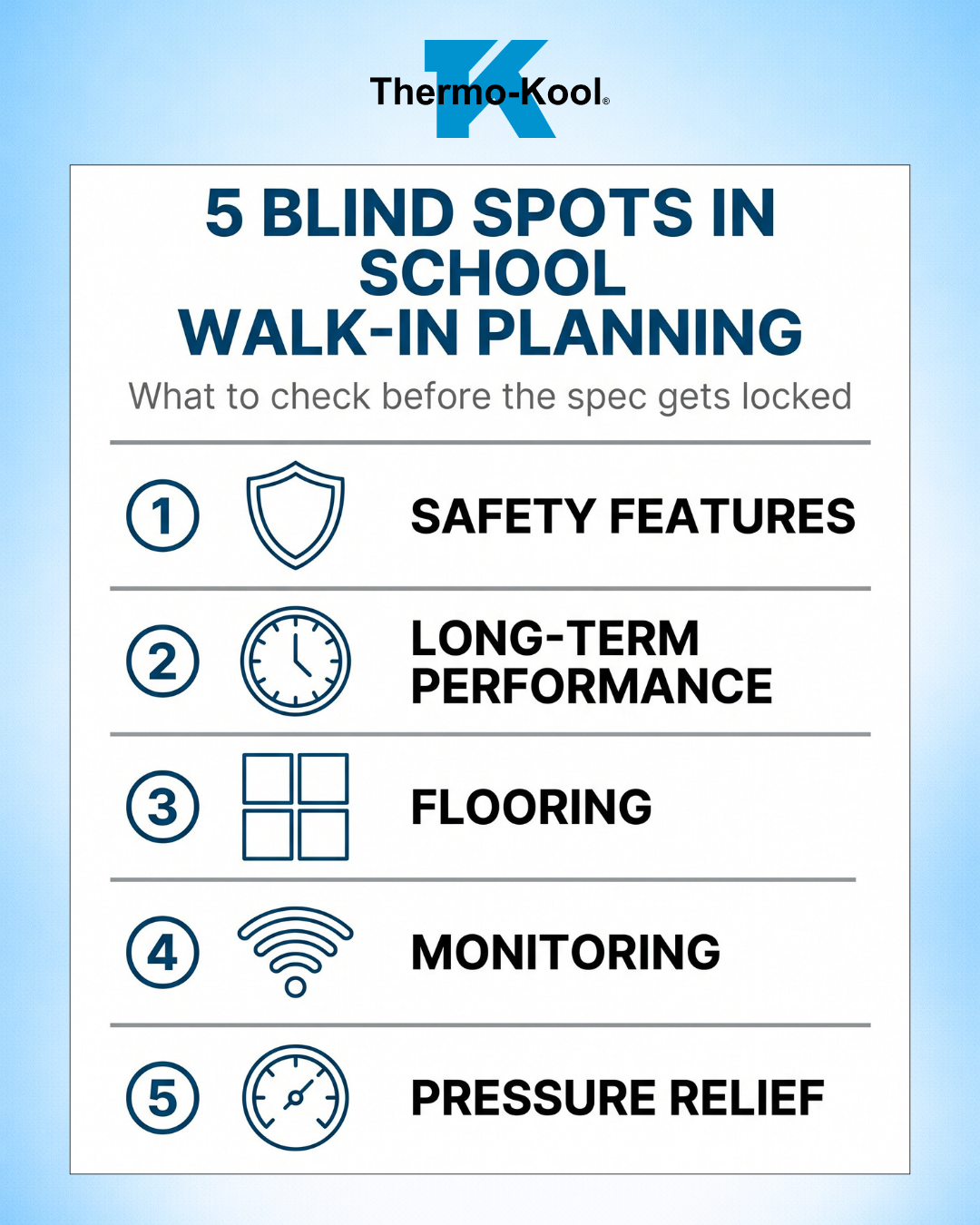
At a minimum: interior emergency release, pressure relief on both cooler and freezer doors, interior lighting with backup access, monitoring for temperature and occupancy, and a flooring assembly suited to the operation. Specify these as standard, not upgrades.
Most K-12 planning cycles span several months between initial concept and spec approval. Larger district-wide projects take longer. The planning window is the only point in the process where changes are inexpensive. After panels are cut, modifications cost significantly more.
Choosing upfront price over long-term performance. Cheap panels, gaskets, and compressors look identical to premium versions on a spec sheet but diverge sharply in year five and beyond. The real cost shows up across the walk-in's full service life, not on the invoice.

We sat down with Accounting Supervisor Justin Pugh to learn about his journey to Thermo-Kool, his thoughts on the industry, and his dream game to...
Utility Specialist James Wheat has been with Thermo-Kool for 24 years. We sat down with him to learn more about him, including his unique birthplace.
The Chill Zone is back! We sat down with receptionist Michaela Betts to learn a little more about her role at Thermo-Kool.