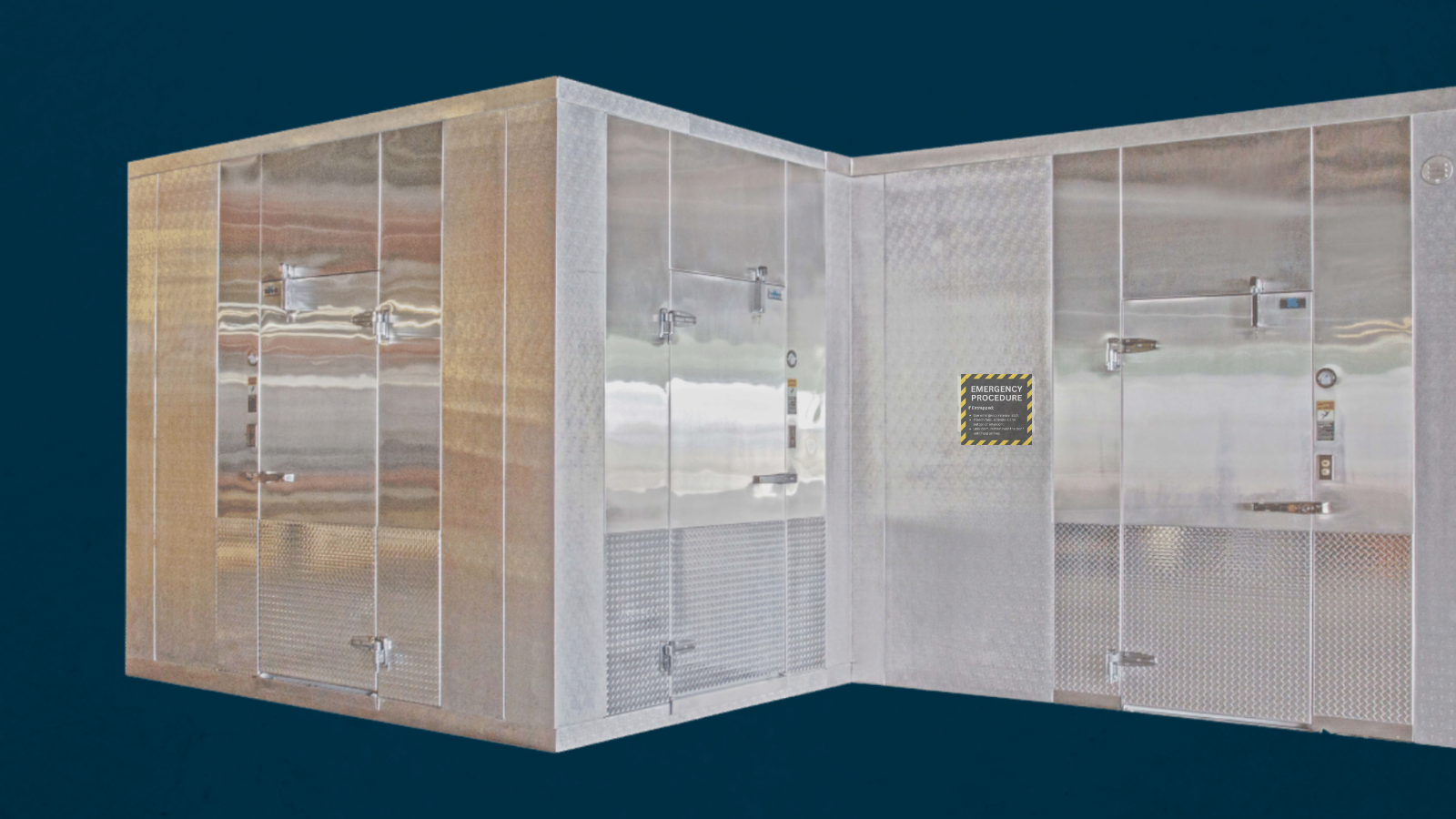
The door handle is cold under your palm, and the latch resists the first pull. Your brain jumps ahead before the seal has had time to breathe. Take a breath. Most "stuck" walk-in doors are not stuck at all. They are equalizing pressure between two different air environments, and the sensation passes within seconds.
Here is what is actually happening, how to respond, and how to tell a normal pressure seal from a real problem.
The First Thing to Do When a Walk-In Door Feels Stuck
Pause. Steady your grip. Push or pull the door with firm, even pressure rather than a sharp jerk.
In most cases, the resistance fades within two to five seconds as the air pressure inside and outside the unit equalizes. Patience, not force, is the correct first response.
If the door still feels locked after a steady push, look for the interior emergency release. On commercial walk-ins, this is typically a knob, lever, or push-button mounted at chest height on the inside of the door. It is designed to operate even if the exterior latch has failed.
%20(1).png?width=1500&height=1500&name=Emergency%20Procedure%20(5%20x%205%20in)%20(1).png)
*** Thermo-Kool's printable emergency procedure sign. Operators can post this inside every walk-in.
Why Most "Stuck Door" Moments Are Normal Physics
When a walk-in door closes, it seals a cold environment from a warmer one. The temperature difference creates a brief pressure differential. Cold air is denser, and until the air molecules on both sides settle into equilibrium, the door resists.
This is not a malfunction. It is insulation doing its job. The heavier the door, the more pronounced the effect, and freezers produce a stronger seal than coolers because of the wider temperature gap. The sensation typically resolves on its own within seconds.
Some walk-in specifications include an airlock relief valve that vents this pressure difference automatically. If a unit has one, operators may never notice the effect at all. If it does not, the brief resistance at the door is the same physics working without the shortcut.
How to Tell Normal Pressure From an Actual Problem
Not every resistant door is a pressure seal. A quick diagnostic:
Time. If more than 30 seconds have passed and the door has not loosened, investigate further.
Sound. An audible alarm or unusual hissing suggests something beyond normal equalization.
Visible damage. A bent latch, cracked hinge, or warped door frame points to a mechanical issue.
Ice at the seal. Frost buildup along the gasket can physically bond the door shut, especially in freezers.
Temperature at the door surface. A door that feels warm to the touch may signal a failed door heater, which leads to condensation, which leads to ice.
If any of these are present, treat the situation as a service call, not a stuck door.
The Built-In Safety Features That Prevent Lock-In
Every commercial walk-in cooler and freezer sold in the United States includes an interior release mechanism. This is not an upgrade or an add-on. It is standard hardware.
On Thermo-Kool walk-ins, the handle assembly is engineered so the entire mechanism releases when pushed from the inside. There is no scenario where a functioning interior release keeps an operator behind a closed door.
This is the engineering that makes "locked in a walk-in" a television plot device rather than a realistic operational risk. The physics of the door may resist briefly. The hardware will not.
For a broader look at daily safety practices and design features that support safe operation, Commercial Walk-In Cooler Safety Made Simple covers monitoring systems, inspection routines, and structural standards.
%20(1).png?width=1400&height=2000&name=EntryExit%20Procedure%20(7%20x%2010%20in)%20(1).png)
*** Thermo-Kool's entry/exit procedure sign covers daily-use safety from approach through exit.
When to Escalate to Maintenance or Service
Some door behavior does warrant a call. Escalate when any of these conditions appear:
- A latch or handle that is visibly damaged or no longer catches cleanly
- Ice forming along the door gasket more than once in the same week
- A door that feels noticeably heavier than it did when the unit was installed
- Repeated stuck-door reports from multiple operators on the same unit
- An alarm that triggers and does not reset after the door closes
Contact the facility's maintenance team first. If they cannot identify the cause, reach out to the manufacturer's service line. Documenting the frequency and conditions of the issue before the call saves time on diagnosis.
Frequently Asked Questions About Walk-In Cooler Doors
Can you actually get locked inside a walk-in cooler?
In practical terms, no. Commercial walk-ins are built with interior release mechanisms that allow the door to open from the inside at all times. The "trapped in a walk-in" scenario belongs to movies, not working kitchens.
Why does the walk-in door feel stuck right after it closes?
The temperature difference between the walk-in interior and the surrounding space creates a brief pressure imbalance. Cold air contracts, warm air pushes against the seal, and until the two sides equalize, the door resists. This resolves within seconds.
Should I be worried if the door takes a few seconds to open?
A few seconds of resistance after the door closes is normal. If the door opens with steady pressure within five seconds, the unit is working as designed.
When should I call for service instead of just waiting it out?
Call when ice appears on the gasket, a latch is damaged, the door has gotten heavier over time, or repeated stuck-door incidents span multiple shifts. Those patterns point to a mechanical or environmental issue, not normal pressure.
Plan Your Walk-In with the Thermo-Kool 3D Configurator
When the time comes to spec a walk-in built for the demands of your operation, the Thermo-Kool 3D Configurator puts the full picture in front of you before a quote is generated. Choose dimensions, door placement, flooring, and accessories in a visual tool built for operators and planners. A step-by-step walkthrough covers the full process.

%20(1).png)
%20(1).png)